Node Editor
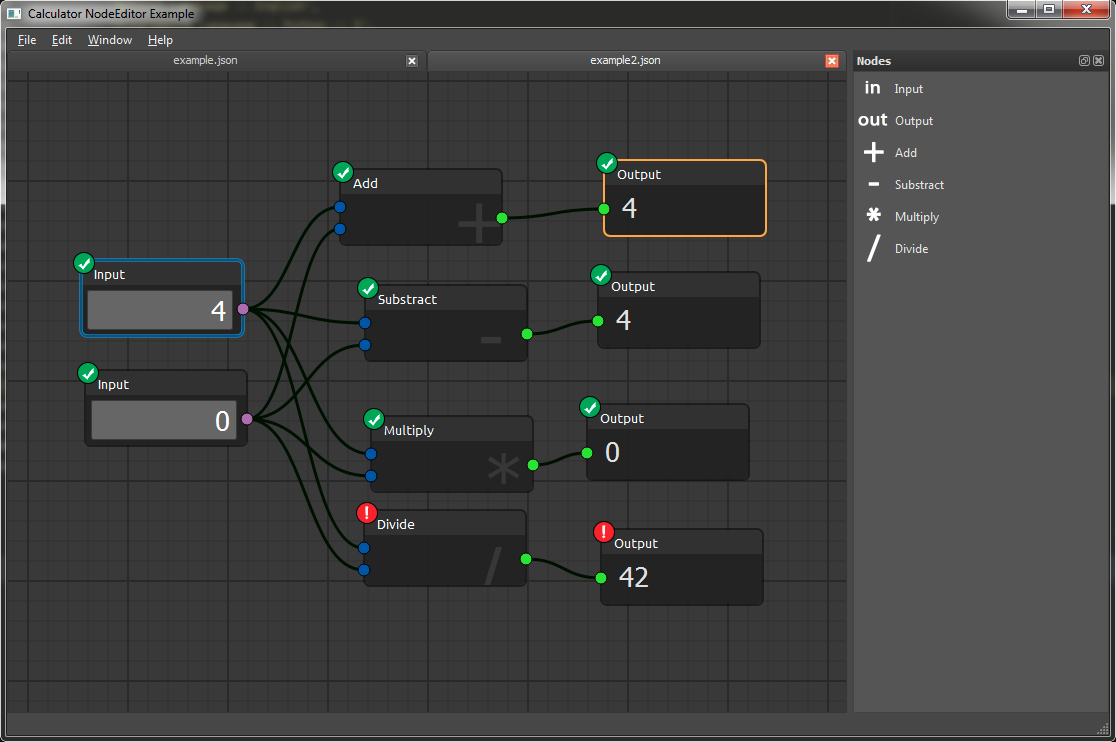
A node editor framework for Qt. Build interactive graph interfaces out of draggable nodes, connectable sockets and edges — with undo/redo, JSON serialization and room for your own evaluation logic.
The framework talks to Qt through QtPy, so the same code runs on PyQt5, PySide2, PyQt6 and PySide6.
Install
The distribution is nodeeditor-qtpy; the import package is nodeeditor.
A first graph
import sys

from qtpy.QtWidgets import QApplication

from nodeeditor.node_editor_widget import NodeEditorWidget
from nodeeditor.node_node import Node
from nodeeditor.node_edge import Edge

app = QApplication(sys.argv)

editor = NodeEditorWidget()
scene = editor.scene

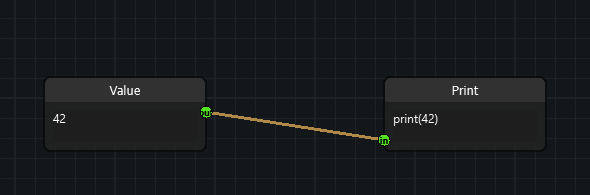
source = Node(scene, title="Value", outputs=[1], output_text=["out"])
sink = Node(scene, title="Print", inputs=[1], input_text=["in"])
Edge(scene, source.outputs[0], sink.inputs[0])

editor.show()
sys.exit(app.exec())
What you get
- Nodes, sockets and edges you fully control: titles, colours, socket types, labels, and the shape each socket is drawn with.
- Undo / redo for every graph change, and serialization to JSON files that diff cleanly in version control.
- Evaluation hooks for your own logic, with dirty/invalid propagation across the graph.
- Editing niceties: hovering effects, edge dragging, edge cutting, snapping, multi-input nodes, node groups, and node/edge labels.
- Theming through a color scheme object, so a whole application can be restyled without touching the graph code.
Where to go next
- Installation — install options, requirements, and what happens when no Qt binding is present.
- Quick start — build your first graph, then customize it.
- Events — subscribe to what happens inside the scene.
- Group nodes — treat a set of nodes as one box.
- API reference — the classes and functions, straight from the source.